Tag: Painless Root Canal Treatment

  • Can Root Canal Treatment be avoided? A real case of preserving a natural tooth.

    Can Root Canal Treatment be avoided? A real case of preserving a natural tooth.

    Dr Srishti Jauhar, Dentist & Clinical Director, The Dentist — 23+ years of clinical experience; 4,500+ root canal treatments; Fellowship in Rotary Endodontics (IARE, USA). She follows an ethical, conservative and patient-first approach, with a strong focus on preserving natural teeth whenever reasonably possible. Through these articles, she shares her clinical experience to help patients better understand their dental problems and treatment options, and make informed decisions about their care.


    In this article

    The Case
    The case · What I found when I examined the tooth · Why I decided not to proceed directly to root canal treatment

    The Treatment & Outcome
    How we treated the tooth while preserving the pulp · Why the tooth needed more than a simple filling · The outcome

    Understanding Your Options
    When root canal treatment is the right treatment · What is vital pulp therapy? · Should you get a second opinion?

    Frequently Asked Questions
    Frequently asked questions about avoiding root canal treatment


    Can root canal treatment always be avoided?

    If you have been told that you need a root canal, it is natural to wonder whether there is another way to save the tooth.

    I understand that hesitation. A root canal is a significant treatment decision, and once it has been recommended, many patients simply want to know one thing:

    “Do I really need it?”

    The answer cannot be determined by pain alone.

    When I assess a tooth that has been advised for root canal treatment, I look at the complete clinical picture: the patient’s symptoms and history, the condition of the tooth and any existing filling or restoration, the findings on examination, pulp sensibility testing and the dental X-rays.

    The purpose is not to avoid root canal treatment at all costs. Root canal treatment is an important and predictable treatment when the pulp is irreversibly damaged or when endodontic treatment is otherwise indicated.

    But there are also cases in which the tooth may still have a reasonable opportunity to be treated more conservatively.

    I recently saw one such case.

    The patient came to me with significant pain in a lower molar and had already been advised root canal treatment at other clinics.

    The symptoms were serious enough that a root canal seemed like a reasonable possibility. But when I examined the tooth carefully, there were findings that made me pause before committing to an irreversible treatment.

    The question became:

    Could we treat the cause of the problem while preserving the tooth’s natural pulp?

    In this case, the answer was yes.

    This is the story of how we approached that tooth, why I decided not to proceed directly to root canal treatment, and what the case can — and cannot — tell us about avoiding a root canal.

    Most importantly, it illustrates a principle I consider fundamental to conservative dentistry:

    The right treatment begins with the right diagnosis.

    Why tooth pain does not always mean you need a root canal

    Tooth pain can be a sign that the pulp inside a tooth is inflamed or infected. But pain by itself does not tell us exactly what is happening inside the tooth.

    Two teeth can produce very similar symptoms — pain, sensitivity to hot or cold, or discomfort while chewing. Yet they require very different treatment.

    A tooth may hurt because of deep decay, a leaking or failing restoration, a crack, trauma, or inflammation of the pulp. In some situations, the pulp may still have the potential to remain healthy after the cause of irritation is treated. In others, the damage may be irreversible and root canal treatment may be the appropriate way to save the tooth.

    This is why I would not make a root canal decision based on the intensity of pain alone.

    What matters is the condition of the pulp

    The pulp is the living tissue inside the tooth that contains nerves and blood vessels. When it becomes severely and irreversibly inflamed or infected, root canal treatment may be necessary.

    But if the pulp is still capable of recovering, there may be circumstances in which a more conservative treatment can be considered.

    The important question is therefore not simply:

    “How much does the tooth hurt?”

    It is:

    “What is causing the pain, and what is the condition of the pulp?”

    Answering that requires a proper clinical assessment rather than relying on any single symptom or test.

    A careful diagnosis comes before the treatment decision

    When I see a patient who has already been advised a root canal, I first want to understand the tooth before deciding what treatment it needs.

    I consider the patient’s symptoms and dental history, examine the tooth and its existing restoration, assess the pulp using appropriate sensibility tests, and study the dental X-rays.

    The X-ray can provide important information about the tooth, its roots and the surrounding bone. Pulp sensibility testing provides another piece of the diagnostic picture.

    Neither should be interpreted in isolation.

    The findings have to be considered together before deciding whether root canal treatment is necessary or whether a conservative approach may be appropriate.

    That distinction is important. Because the aim is not to avoid root canal treatment simply because a patient wants to avoid it. The aim is to avoid unnecessary treatment while providing root canal treatment when the tooth genuinely needs it.

    That is the approach I took with the patient in this case.

    How I assess whether a root canal is actually necessary

    When a patient comes to me after being advised a root canal, I do not want to make the decision simply by looking at the previous recommendation. I want to understand the tooth for myself.

    There are several pieces to that assessment, and each tells me something different.

    Your symptoms and dental history

    I start by listening carefully to what the patient has experienced.

    When did the pain begin? Is it triggered by cold or hot foods? Does it stop quickly, or does it linger? Does the tooth hurt when biting or chewing? Has there been swelling? Has the tooth been filled, treated or injured previously?

    These details help build a picture of what may be happening, but symptoms alone are not enough to establish the diagnosis.

    Clinical examination

    I then examine the tooth itself.

    First, I look for visible decay, a failing or leaking restoration, cracks or other structural problems. Then I also assess the tooth. And the surrounding tissues clinically to understand whether the symptoms can be traced to this particular tooth.

    Sometimes the source of pain is not where a patient expects it to be, which is another reason a careful examination matters.

    Pulp sensibility testing

    The next part of the assessment is understanding how the pulp is responding.

    Cold testing and, where appropriate, other sensibility tests can provide useful information about the sensory response of the pulp. These tests do not directly measure the blood supply of the pulp, so they are more accurately described as pulp sensibility tests rather than vitality tests.

    The result is interpreted alongside the patient’s symptoms, clinical findings and radiographs. A response to testing is an important piece of information, but it does not by itself prove that a tooth does or does not need root canal treatment.

    Dental X-rays and the surrounding bone

    Radiographs help me look beyond what can be seen clinically.

    I assess the depth and extent of existing restorations or decay, the roots and surrounding bone, and whether there are any visible changes around the root tip.

    The absence of a visible change around the root tip can be reassuring, but it does not by itself rule out significant pulpal disease. The radiograph has to be interpreted together with the clinical findings.

    Looking at the whole picture

    Ultimately, the decision is not based on one symptom, one X-ray or one test.

    It comes from putting all of the information together:

    What is the patient experiencing? What is happening in the tooth? How is the pulp responding? What do the radiographs show? And is there a conservative treatment that has a reasonable chance of preserving the tooth and its pulp?

    That is the assessment I made in the case I am about to describe.

    The case: a painful lower molar that had already been advised for root canal treatment

    The patient came to me with significant pain in a lower right molar — Tooth 46.

    Eating had become difficult. Hot and cold foods were triggering pain, and there was lingering discomfort that had begun to interfere with everyday life.

    The tooth had previously been restored with a filling, and the symptoms had gradually worsened over time.

    Before coming to The Dentist, the patient had consulted multiple clinics and had been advised to undergo root canal treatment.

    Given the symptoms, that recommendation was understandable.

    But the patient wanted another opinion before proceeding with an irreversible treatment.

    The question was simple:

    Could this tooth still be treated without removing its natural pulp?

    To answer that, I needed to assess the tooth carefully rather than assume that the previous recommendation was either right or wrong.

    I began with the clinical and radiographic findings.

    What I found when I examined the tooth

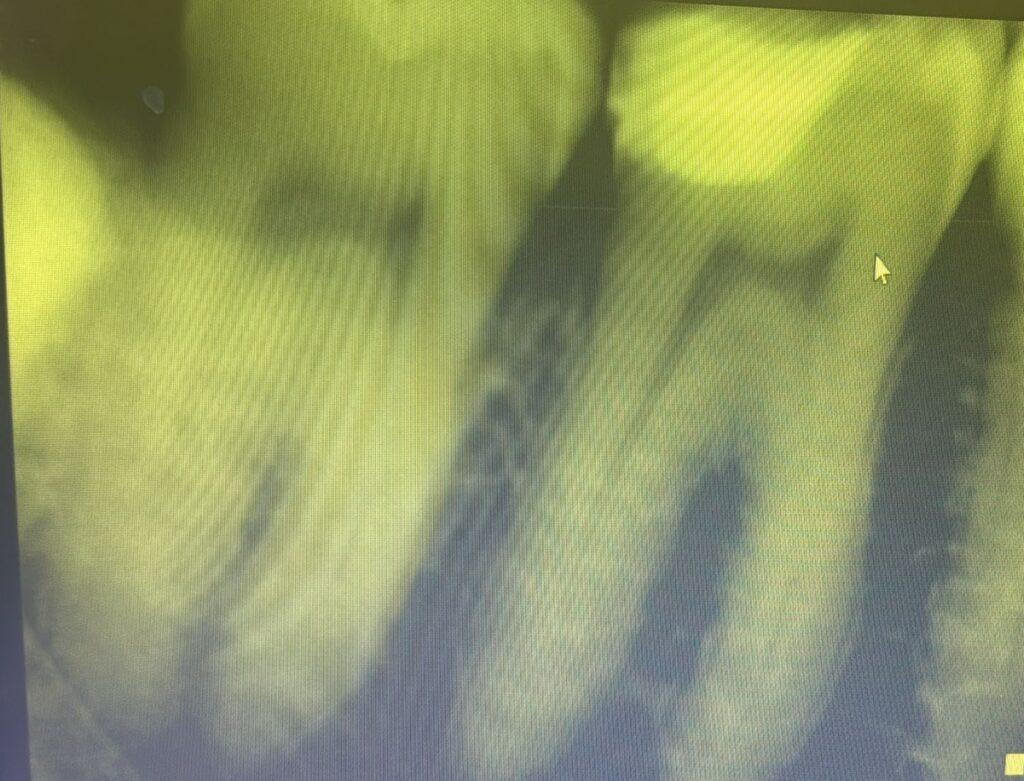
    The first part of the assessment was the dental X-ray.

    (Pre-treatment dental X-ray showing the deep existing restoration in the affected lower molar, with no visible periapical changes around the root tip.)

    It showed a deep, old filling in the affected molar. The seal around the restoration appeared to have broken down, allowing the possibility of bacterial leakage beneath the filling and irritation of the deeper tooth structure.

    This provided a possible explanation for the patient’s symptoms.

    But there was another important finding.

    There were no visible periapical changes around the root tip.

    In other words, the X-ray did not show a visible abnormality in the surrounding bone at the apex of the tooth.

    That was useful information, but it was not enough on its own to decide against root canal treatment.

    An X-ray cannot tell us everything about the condition of the pulp. I therefore needed to consider the clinical findings and the pulp’s response to sensibility testing as well.

    The pulp was still responding

    The tooth responded positively to pulp sensibility testing.

    This was an important finding because it indicated that the pulp was responding to the test stimulus.

    However, I did not interpret that result in isolation. A positive sensibility response does not, by itself, establish that the pulp is healthy or that root canal treatment is unnecessary.

    I considered it together with the patient’s symptoms, the clinical examination and the radiographic findings.

    Taken as a whole, the findings suggested that there was a possibility of treating the tooth conservatively rather than proceeding directly to root canal treatment.

    That possibility needed to be weighed carefully against the risks of preserving the pulp.

    The next decision was therefore not simply “How can we avoid a root canal?”

    It was:

    “Does this tooth have a reasonable chance of recovering if we remove the source of irritation and restore it appropriately?”

    Why I decided not to proceed directly to root canal treatment

    At this point, I had to make a clinical decision.

    The patient was experiencing significant pain, so simply assuming that the tooth could be left untreated was not an option. At the same time, the findings did not make it necessary to proceed immediately with root canal treatment without considering whether the natural pulp could still be preserved.

    Several findings were important when considered together:

    • The tooth had a deep, old filling that appeared to have lost its seal.
    • There was a possible source of bacterial leakage and irritation beneath the existing restoration.
    • The tooth responded to pulp sensibility testing.
    • There were no visible periapical changes around the root tip.
    • The tooth still had sufficient structure to consider restorative treatment.

    None of these findings, by itself, was enough to rule out root canal treatment. The decision came from looking at the complete clinical picture.

    My thinking was that if the source of irritation could be removed and the tooth could then be properly sealed and restored, there was a reasonable possibility that the pulp could remain functional and the tooth could settle.

    So, rather than removing the pulp immediately, I decided to take a conservative approach and treat the underlying problem while giving the natural pulp an opportunity to recover.

    This was not a decision to avoid root canal treatment at all costs.

    It was a decision to preserve the pulp because, in this particular case, I felt there was a reasonable and clinically appropriate opportunity to do so.

    It is also important to say that this does not necessarily mean that the earlier recommendations for root canal treatment were wrong. Dentists may reach different treatment decisions based on the findings available to them, the clinical examination and how the symptoms and tests are interpreted.

    The important question for me was not whether a root canal had previously been recommended.

    It was whether, after my own examination, this tooth could reasonably be treated without proceeding directly to root canal treatment.

    In this case, I felt it was worth trying.

    How we treated the tooth while preserving the pulp

    Once we decided to take a conservative approach, the next priority was to remove the source of irritation and restore the tooth in a way that protected the remaining healthy tooth structure.

    The treatment was carried out under local anaesthesia and with a rubber dam to maintain a clean, controlled working field.

    The old filling was carefully removed so that I could assess the tooth underneath it. The compromised tooth structure was then selectively removed, while taking care not to sacrifice sound tooth structure unnecessarily.

    At the deeper part of the cavity, a biocompatible material was placed to help protect the underlying pulp.

    The tooth was then rebuilt using a fibre-reinforced composite material.

    Because the tooth had already lost a significant amount of structure, I did not consider a simple filling sufficient for long-term restoration. We therefore planned an indirect onlay to provide better coverage and protection.
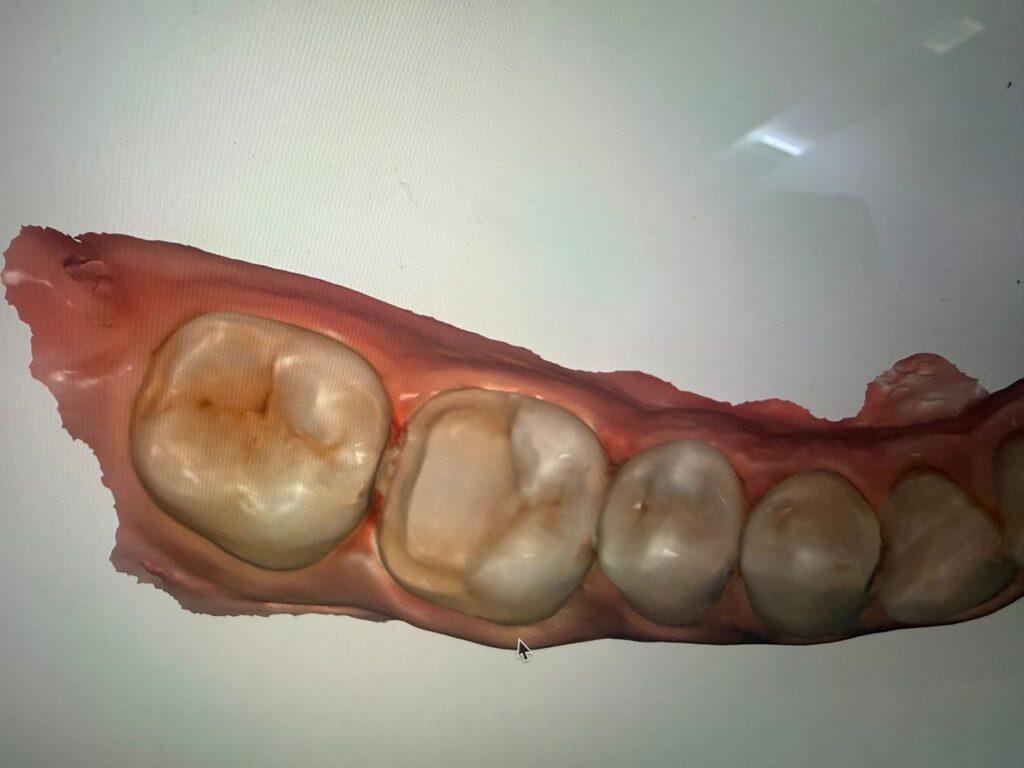
    The tooth was digitally scanned, and the onlay was subsequently bonded to the tooth using adhesive cement.

    The objective throughout the procedure was straightforward:

    Remove the source of irritation, protect the remaining tooth structure and pulp, and restore the tooth without unnecessarily removing the natural pulp.

    This approach allowed us to preserve the tooth while still providing the structural protection it needed.

    Why the tooth needed more than a simple filling

    Preserving the pulp did not mean that the tooth could simply be given another filling and left as it was.

    The old restoration had already failed to provide an adequate seal, and removing the compromised filling and damaged tooth structure left the molar with a significant amount of structural loss.

    A tooth in this condition needs to be restored with its long-term strength and function in mind.

    That is why, after protecting the deeper part of the tooth and rebuilding the lost structure with fibre-reinforced composite, we chose an indirect onlay rather than relying on a conventional filling alone.

    The onlay provided additional coverage and helped protect the remaining tooth structure during normal chewing.

    This distinction is important.

    Preserving the natural pulp and restoring the tooth properly are two separate parts of the treatment.

    The goal was not simply to avoid a root canal. It was to leave the patient with a tooth that was both biologically preserved and adequately restored.

    The outcome: the pain resolved and the natural tooth was preserved

    After the treatment, the patient’s pain settled and the tooth became comfortable enough for normal chewing again.

    The sensitivity that had been troubling the patient also reduced significantly.

    Most importantly, we were able to preserve the natural tooth without proceeding with root canal treatment at that stage.

    For me, this was a satisfying outcome not simply because we avoided a root canal, but because we were able to address the likely source of the problem while preserving the tooth’s natural pulp and restoring the tooth appropriately.

    However, I would not want this single case to create the impression that a painful tooth can generally be treated without root canal treatment.

    It cannot.

    The outcome in this case depended on the condition of this particular tooth, the clinical findings and the assessment made before treatment. Other teeth with similar symptoms may have a very different diagnosis and may genuinely require root canal treatment.

    That distinction is important when considering whether a root canal can be avoided.

    Does this mean every painful tooth can avoid a root canal?

    No.

    This case should not be interpreted as evidence that root canal treatment is unnecessary whenever a tooth is painful.

    Some painful teeth have pulp inflammation or damage that cannot predictably recover. In those situations, root canal treatment may be the appropriate way to remove the diseased pulp, control infection and retain the tooth.

    Other teeth may have a different problem that can be managed more conservatively, provided the tooth and pulp meet the clinical requirements for that approach.

    That is why I would not make the treatment decision based on pain intensity alone.

    Two patients can have similar symptoms but require completely different treatment.

    The important questions are:

    • What is causing the pain?
    • What is the condition of the pulp?
    • What does the clinical examination show?
    • What do the X-rays show?
    • Is the tooth structurally restorable?
    • Is there a reasonable and predictable way to treat the problem while preserving the pulp?

    If the answer to these questions supports pulp preservation, a conservative treatment may be worth considering.

    If the pulp is irreversibly damaged, infected or otherwise unlikely to recover, trying to avoid a root canal can do more harm than good.

    The goal should not be to avoid root canal treatment. The goal should be to choose the least invasive treatment that is appropriate and predictable for that particular tooth.

    When root canal treatment is the right treatment

    Root canal treatment is an important treatment when the dental pulp has been irreversibly damaged or when endodontic treatment is otherwise indicated.

    The aim is not to avoid root canal treatment whenever possible. It is to recognise when the pulp is unlikely to recover and treat the tooth appropriately rather than trying to preserve tissue that cannot be predictably preserved.

    Root canal treatment may be appropriate when the clinical diagnosis indicates irreversible pulp damage or pulp necrosis, particularly when the tooth is otherwise restorable.

    Symptoms that may raise concern include spontaneous pain, pain that lingers after a hot or cold stimulus, pain that becomes increasingly difficult to manage, or other findings suggesting significant pulpal disease. However, symptoms alone do not establish the diagnosis.

    The diagnosis needs to be based on the complete assessment of the tooth, including the patient’s history, clinical examination, pulp sensibility testing and appropriate dental X-rays.

    There are also situations where the problem is no longer limited to the pulp. Infection and inflammatory changes around the root may develop, and these findings can influence the treatment decision.

    In such cases, trying to avoid root canal treatment simply because the patient would prefer a more conservative option may not be in the patient’s best interest.

    A root canal is not a treatment to be feared or avoided at all costs. When the diagnosis indicates that it is the appropriate treatment, it can be an important way of retaining a natural tooth rather than extracting it.

    The key is knowing when the tooth has a reasonable opportunity for pulp preservation — and when it does not.

    What is vital pulp therapy?

    Vital pulp therapy refers to treatments designed to preserve the health and function of all or part of the dental pulp rather than removing the entire pulp through root canal treatment.

    It can be considered in appropriately selected teeth when the pulp has a reasonable opportunity to remain healthy or recover after the source of irritation is addressed.

    The treatment can take different forms depending on the condition of the tooth and the extent of pulpal involvement. The appropriate procedure therefore cannot be decided simply from the fact that a tooth is painful or that an X-ray looks reassuring.

    A careful diagnosis is essential before considering pulp-preserving treatment.

    This includes assessing the patient’s symptoms and history, examining the tooth, carrying out appropriate pulp sensibility testing and evaluating diagnostic-quality dental X-rays. The condition of the tooth and its restorability also matter.

    In selected cases, preserving the pulp can offer an alternative to removing it completely.

    But vital pulp therapy is not suitable for every tooth that has been advised for root canal treatment.

    The diagnosis, extent of pulpal damage, condition of the tooth and surrounding tissues, and the clinical judgement of the treating dentist all need to be considered.

    In the case described in this article, the decision was made after assessing the individual tooth rather than applying a general rule that root canal treatment should be avoided.

    That is an important distinction.

    Pulp preservation is a treatment option in appropriately selected cases — not a promise that every painful tooth can be saved without a root canal.

    Should you get a second opinion before having a root canal?

    If you have been advised to have a root canal, getting a second opinion can be reasonable when you are uncertain about the diagnosis or want to understand whether there are other appropriate treatment options.

    A second opinion does not necessarily mean that the first dentist was wrong.

    Root canal treatment may be exactly the right treatment for a particular tooth. But because it is an irreversible procedure, it is reasonable to understand why it has been recommended and whether the tooth has any realistic alternative treatment options before proceeding.

    When seeking another opinion, take your existing dental X-rays, treatment records and any relevant reports with you. It is also useful to explain clearly what symptoms you have experienced, when they started and what makes them better or worse.

    The dentist providing the second opinion should ideally assess the tooth independently rather than simply looking at the previous recommendation.

    That assessment may include:

    • Reviewing your symptoms and dental history
    • Examining the tooth and surrounding tissues
    • Performing appropriate pulp sensibility tests
    • Reviewing existing dental X-rays
    • Assessing the remaining tooth structure and restorability
    • Explaining whether root canal treatment is necessary, whether another treatment may be appropriate, or whether further investigation is needed

    The purpose of a second opinion should not be to find someone who will simply say “you don’t need a root canal.”

    It should help you understand what is actually happening inside and around the tooth, why a particular treatment has been recommended, and what reasonable alternatives exist, if any.

    That is the kind of second opinion I believe is most useful to a patient.

    Questions to ask your dentist before agreeing to a root canal

    Before proceeding with root canal treatment, it is reasonable to understand why it has been recommended and what your options are.

    You may want to ask:

    • What is the diagnosis for this tooth?
    • What findings indicate that I need a root canal?
    • What did the pulp sensibility tests show?
    • What do my X-rays show?
    • Is the tooth structurally restorable?
    • Is there any reasonable way to preserve the pulp in my particular case?
    • If we do not proceed with a root canal immediately, what are the risks?
    • If a conservative treatment is attempted, how will we know whether it has worked?
    • If the conservative approach does not succeed, what would the next treatment be?
    • Are there any cracks, decay or problems with an existing filling that need to be addressed?

    You do not need to decide based simply on whether the words “root canal” sound alarming.

    What matters is understanding the diagnosis, the reasoning behind the recommendation and the realistic alternatives, if any.

    A good treatment decision should leave you understanding what is wrong with the tooth, why the proposed treatment is appropriate, and what you can reasonably expect from each available option.

    If you are travelling to Delhi for a second opinion

    If you are travelling to Delhi and have already been advised root canal treatment, it can be useful to have your existing dental records reviewed before you make travel arrangements.

    You can share your recent dental X-rays, reports and relevant treatment history with the clinic for an initial discussion. A video consultation may also help you understand what information is available and what may need to be assessed in person.

    However, a remote consultation has limitations.

    A dentist cannot fully examine the tooth, perform pulp sensibility testing or assess the tooth clinically through a video call. The final treatment decision may therefore need to wait until an in-person examination and appropriate diagnostic tests have been completed.

    If you are travelling specifically for a second opinion, it is helpful to bring:

    • Recent dental X-rays, preferably the original digital files if available
    • Previous treatment records or reports
    • A list of treatments already performed on the tooth
    • Information about when the pain or sensitivity started and how it has changed
    • Details of any medication prescribed for the problem

    Having this information in advance can make the consultation more useful and may help the dentist understand your case before you arrive.

    For international patients, the practical question is often not simply “Can I have a consultation?”

    It is also:

    “Can I understand my treatment options before I travel, and can the treatment be planned realistically around my visit?”

    That is something worth discussing with the dental team before making travel arrangements.

    Frequently asked questions about avoiding root canal treatment

    Can root canal treatment be avoided?

    Sometimes, but not in every case.

    Whether a root canal can be avoided depends on the condition of the pulp, the cause of the problem, the condition and restorability of the tooth, and the findings from the clinical examination, pulp sensibility testing and dental X-rays.

    If the pulp has a reasonable opportunity to recover, a pulp-preserving approach may sometimes be considered. If the pulp is irreversibly damaged or infected, root canal treatment may be the appropriate treatment.

    Does severe tooth pain always mean I need a root canal?

    No. Severe pain can occur for different reasons, and the intensity of pain alone does not establish whether root canal treatment is necessary.

    The cause of the pain and the condition of the pulp need to be assessed before deciding on treatment.

    What tests are used to decide whether I need a root canal?

    A dentist may consider your symptoms and dental history, examine the tooth and surrounding tissues, perform pulp sensibility testing and take appropriate dental X-rays.

    No single test should normally be interpreted in isolation.

    Cold and electric tests are more accurately described as pulp sensibility tests. They assess the pulp’s response to a stimulus but do not directly measure its blood supply or prove that the pulp is healthy.

    Can an inflamed pulp heal without root canal treatment?

    In some appropriately selected cases, the pulp may be capable of recovering after the source of irritation is removed and the tooth is properly treated and sealed.

    However, this depends on the nature and extent of the pulpal inflammation and the overall condition of the tooth.

    A dentist needs to determine whether pulp preservation is a reasonable and predictable option in that particular case.

    What are the alternatives to root canal treatment?

    There is no single alternative that is suitable for every tooth.

    Depending on the diagnosis and condition of the tooth, treatment may involve removing decay or a failing restoration and restoring the tooth, or a pulp-preserving procedure such as vital pulp therapy.

    In some cases, root canal treatment remains the appropriate option.

    The important point is to establish the diagnosis before deciding which treatment is suitable.

    When is root canal treatment unavoidable?

    There are situations where the pulp is irreversibly damaged or has become necrotic, or where endodontic treatment is otherwise indicated.

    In such circumstances, attempting to avoid a root canal may not be in the patient’s best interest.

    The final decision should be based on the clinical diagnosis and the condition of the individual tooth.

    Is it worth getting a second opinion about a root canal?

    If you are uncertain about the diagnosis or want to understand whether other appropriate treatment options exist, a second opinion can be useful.

    It should not be about finding someone who will automatically avoid a root canal.

    A good second opinion should help you understand why the treatment has been recommended, what the diagnosis is, and whether there are any reasonable alternatives for your particular tooth.

    Can I discuss my dental X-rays with The Dentist before travelling to Delhi?

    Yes, you can contact the clinic to discuss your case and share available dental X-rays or reports before travelling.

    A preliminary discussion or video consultation can help you understand what can be assessed remotely and what may need to be examined in person.

    However, a remote consultation cannot replace a clinical examination or diagnostic tests such as pulp sensibility testing. A final treatment decision may therefore require an in-person assessment.

    Have you been advised a root canal and want another opinion?

    If you have been advised root canal treatment and are unsure whether it is the right treatment for your tooth, you are welcome to discuss your case with us.

    Bring your existing dental X-rays and treatment records if you have them. If you are travelling to Delhi, you can also contact the clinic in advance to discuss whether a video consultation would be useful before your visit.

    The purpose of an assessment is not to promise that a root canal can be avoided.

    It is to understand what is happening with your tooth, whether the pulp can reasonably be preserved, and which treatment is most appropriate for your particular situation.

    If a root canal is genuinely indicated, we will explain why. And if there is a reasonable opportunity to preserve the natural pulp, that option can also be discussed.

    If you have been advised a root canal and would like an independent clinical opinion, you can contact The Dentist to discuss your case.


    In some cases, an extraction may also be advised. We saved the natural tooth instead.

    The true cost of Root Canal Treatment in India (2026).

    Learn more from Happy Patient Reviews.


    To schedule your appointment with The Dentist tap on the Schedule an Appointment tab displayed on this page.

    For directions: The Dentist on Google Maps


  • How do I find the best Root Canal Dentist in New Delhi?

    How do I find the best Root Canal Dentist in New Delhi?

    Looking for the best Root Canal Dentist in New Delhi is not as challenging as the “fear of treatment & pain” that most of us have in our minds.

    When it comes to Dental Treatments, especially Root Canal Treatments, ‘fear of pain’ is the first thought that strikes first to all of us.

    Getting the whole treatment done seems like a tough task which one avoids for as long as possible.

    It is not that one can do away with the treatment, but delaying any dental treatment is the most common phenomenon observed among people.

    Among all, people fear the Root Canal Treatments & Tooth Extraction the most, more so for the Wisdom teeth.

    The fear is obvious and also justifiable to some extent.

    However, with advanced techniques and instruments, the whole dental treatment experience could be as easy as it could be.

    Especially the Root Canal Treatments have become very advanced these days.

    If a Dentist follows advanced techniques and works with new technologies, one can make the entire Root Canal Treatment procedure very easy & comforting for the patients.

    Meet The Dentist.

    The Dentist is an Advanced Dental Clinic in South Delhi, where the Doctors specialize in Root Canal Treatments.

    The Doctors at The Dentist have been practicing dentistry for the past 18-20 years.

    The chief Doctor at The Dentist is a Certified Endodontist who specializes in Root Canal Treatment.

    She has completed 2000+ Root Canal Treatment cases successfully.

    And most of the Root Canal Treatment cases she has undertaken were treated in just a Single Visit for the patient.

    And during the Root Canal Treatment, about 90% of the patients either did not experience any pain or just a minimal non-troubling pain during the treatment.

    Here are 4 compelling reasons why you should visit The Dentist when you are looking for the best Root Canal Treatment expert in Delhi:

    1) Single Visit Root Canal Treatments

    Most of the patients who visited The Dentist for a Root Canal Treatments had to visit the clinic just once.

    In most cases, a Single Visit Root Canal Treatment is possible. Unless if the treatment is a complex one.

    Under a typical scenario where other Dentists don’t use advanced techniques for treatments, Patients usually end up visiting their Clinics multiple times for just a Root Canal Treatment.

    2) Almost painless Root Canal Treatments

    More than 90% of patients treated at The Dentist did not experience any pain while undergoing the root canal treatment. Or in some cases, they just had minimal non-troubling tooth pain.

    At The Dentists, Doctors use the most advanced techniques & instruments for Root Canal Treatments, which in turn ensures a painless treatment.

    3) Treatment Assurance

    The procedures followed for root canal treatment at The Dentist assures a permanent fix of the pain, without the loss of the tooth.

    Usually, a Patient never faces any difficulty or pain post the treatment, all throughout his/her life.

    And if by any chance, you still experience pain or discomfort in the treated tooth, the Doctors here address your concern immediately, at no extra cost.

    The Doctors at The Dentist assure you of the treatment here.

    4) Root Canal Treatment with an accuracy of 97.5%

    At The Dentist, Doctors use the world’s best technologies for Root Canal Treatments.

    The instruments used here are perfect by design and technology that goes behind it.

    These instruments and designed to deliver accurate measurements, even in extreme cases of the presence of blood or discharges experienced during the treatment.

    The devices used at The Dentist have patented technologies that deliver an accuracy rate of 97.5%

    In turn, you undergo an accurate Root Canal Treatment.

    This accuracy further ensures that there would be no trouble in the future.

    PS: 11 promising reasons why you should visit The Dentist.


    How should I schedule my appointment at The Dentist?

    To schedule your appointment at The Dentist, you can choose any of the following ways:

    • You can schedule your appointment online. Just click here.
    • You can also write to the doctor at [email protected]
    • You can call The Dentist at 9971711810 or 011-46074994 & get your appointment confirmed
    • We prefer a prior appointment before any treatment or consultation. However, if you are in Delhi, you can also walk-in at a convenient time. Monday through Saturday, in between, 10 am till 7 pm.

    For directions to The Dentist on Google Map, please click here.

    Click here to see what the Patients at The Dentist say.

  • True Cost of Root Canal Treatment in India (2026): Why it matters.

    True Cost of Root Canal Treatment in India (2026): Why it matters.

    Dr Srishti Jauhar, Dentist & Clinical Director, The Dentist — 23+ years of clinical experience; 4,500+ root canal treatments; Fellowship in Rotary Endodontics (IARE, USA). She follows an ethical, conservative and patient-first approach, with a strong focus on preserving natural teeth whenever reasonably possible. Through these articles, she shares her clinical experience to help patients better understand their dental problems and treatment options, and make informed decisions about their care.


    In this article

    Understanding Root Canal Treatment

    Do you actually need Root Canal Treatment? · Why does the cost depend on the tooth? · How many visits will Root Canal Treatment take?

    Understanding the Cost

    How much does Root Canal Treatment cost in India? · What are you really paying for? · Why can Root Canal Treatment cost so differently?

    Comparing Your Treatment Options

    Why accuracy matters in Root Canal Treatment · Is the cheapest Root Canal Treatment actually the cheapest option? · Does a higher-priced Root Canal Treatment mean better treatment?

    For Expats & International Patients

    How does India compare internationally? · What should you know before travelling to India for Root Canal Treatment? · How should you compare two treatment quotes?


    Understanding what affects the cost of a Root Canal Treatment, and why the cheapest quote is not always the true cost of saving your tooth.


    The price you see is not always the cost of the treatment

    When you start looking for the cost of Root Canal Treatment in India, you may find surprisingly different prices for what appears to be the same treatment. One clinic may quote a few thousand rupees, while another may quote considerably more.

    So, what explains the difference?

    The answer is that the price of a Root Canal Treatment does not depend only on the procedure itself.

    It can reflect the complexity of the tooth, how carefully the diagnosis is made, the equipment and techniques used, the materials used to clean and seal the canals, the time required, and what is planned to restore the tooth afterwards.

    There is another question that is just as important as “How much does a Root Canal Treatment cost?”

    “What am I actually getting for that price?”

    This becomes particularly important if you are travelling to India for dental treatment or are an expat living in Delhi or another Indian metro city.

    When you have limited time, comparing treatment simply by the number on a quotation may not tell you enough about the care your tooth actually needs.

    In this article, I will explain the cost of Root Canal Treatment in India in 2026, what can make one treatment more expensive than another, how the cost of a Root Canal relates to the crown or other restoration that may follow, and what I believe patients should look at before choosing a treatment based on price alone.

    How much does Root Canal Treatment cost in India in 2026?

    The cost of Root Canal Treatment in India can vary considerably. There is no single price that applies to every tooth or every patient because the treatment required depends on the condition and anatomy of the tooth.

    As a broad guide, Root Canal Treatment in India may range from a few thousand rupees to considerably more in clinics where more time, advanced equipment, specialist expertise or complex treatment is involved.

    For an individual patient, however, the more useful question is not simply “What is the cost of a root canal?” but “What does the quoted cost include, and what treatment does my tooth actually need?”

    A quotation for Root Canal Treatment may cover the cleaning, shaping and sealing of the root canals, but other parts of the treatment may be charged separately. For example, the final restoration of the tooth may involve a filling, core build-up or crown, depending on how much tooth structure remains and which tooth is being treated.

    This is why two apparently similar root canal treatment costs can be quite different without necessarily representing the same treatment.

    What is usually included in the quoted RCT cost?

    The exact inclusions vary between clinics, so it is worth asking for a clear breakdown before starting treatment.

    Depending on the clinic and the case, the quoted RCT cost may include:

    • Clinical examination and treatment planning
    • Dental X-rays or other necessary imaging
    • Cleaning and shaping of the root canals
    • Disinfection of the canals
    • Filling and sealing of the canals
    • Materials and instruments used during the procedure
    • Follow-up related to the Root Canal Treatment

    For more complicated teeth, additional procedures or appointments may be necessary.

    What may cost extra?

    The cost of a Root Canal Treatment should also be considered alongside what is needed to restore and protect the tooth afterwards.

    Depending on the condition of the tooth, additional costs may include:

    • A temporary or permanent filling
    • Core build-up or other restoration
    • A dental crown
    • Additional imaging
    • Treatment of a complicated or previously treated tooth
    • Re-treatment if an earlier Root Canal has failed
    • Other procedures needed before the tooth can be properly restored

    For this reason, if you are comparing root canal treatment costs in India, ask whether the quotation is for the Root Canal alone or for the complete treatment required to bring the tooth back to function.

    The price of the Root Canal is one part of the cost of saving and restoring the tooth.

    Indicative cost of Root Canal Treatment in India in 2026

    There is no single price for Root Canal Treatment across India. The cost of Root Canal Treatment can vary depending on the tooth being treated, the complexity of its root canal anatomy, whether it is a first-time treatment or a re-treatment, the clinical expertise involved, the technology and materials used, and what is included in the quotation.

    The table below provides an indicative reference range to help you understand the broad range of RCT costs that patients may encounter in India in 2026. These figures are not a fixed national price and should not be taken as a quotation for your individual tooth.

    Type of Root Canal TreatmentIndicative higher-end private clinic rangeIndicative lower-priced private clinic range
    Simple case – single canal, usually a front tooth₹7,000–₹8,000₹1,500–₹3,000
    Moderate case – premolar or a tooth with more complex anatomy₹9,000–₹10,000₹3,500–₹5,500
    Complex case – molar, multiple canals or more difficult anatomy₹11,000–₹12,000₹4,000–₹7,000
    Re-RCT – retreatment of a previously treated tooth₹12,000–₹15,000₹5,000–₹8,000

    (Note: The figures above are indicative ranges intended to illustrate how Root Canal Treatment costs can vary in India in 2026. Actual fees vary by clinic, tooth, case complexity, materials, treatment requirements and what is included in the quoted fee. These figures should not be treated as fixed or standardised market prices.)

    The important point is that these numbers should not be viewed as a simple comparison between a “good” price and a “bad” price.

    A lower quotation may represent a different scope of treatment or different inclusions, while a higher quotation does not automatically mean that the treatment is better or more appropriate.

    For an individual patient, the written treatment plan and quotation from the treating dentist are much more meaningful than a general market range.

    It is also important to check whether the quoted cost of a root canal includes the consultation, diagnostic imaging, temporary restoration, final restoration or crown, and follow-up care.

    Two quotations that appear to be for the same Root Canal Treatment may therefore represent quite different overall treatment plans.

    The price of the Root Canal Treatment is only one part of the cost of saving and restoring the tooth.

    Why does Root Canal Treatment cost so differently from one clinic to another?

    When patients compare the cost of Root Canal Treatment between different clinics, they are often surprised by how much the quotations can differ.

    As a dentist, I understand why this can be confusing. If the treatment is called “Root Canal Treatment” in both places, it is natural to assume that the procedure—and therefore the price—should be more or less the same.

    In reality, the treatment required can be quite different from one tooth to another. The way the tooth is diagnosed, the complexity of its root canal anatomy, the techniques and materials used, the time involved and what happens after the Root Canal Treatment can all influence the overall cost.

    This is why I would not recommend choosing a Root Canal Treatment simply by comparing the number on two quotations.

    The experience of the dentist treating your tooth

    Root Canal Treatment involves working inside very small and sometimes complex spaces within a tooth. The dentist needs to identify the canals, clean and disinfect them thoroughly, and then seal them appropriately.

    The experience and training of the dentist can therefore be one of the factors reflected in the treatment fee.

    A straightforward Root Canal Treatment on a front tooth is also very different from treating a molar with several or difficult-to-access canals. Looking only at the words “RCT” on a quotation does not tell you how demanding the treatment may actually be.

    The complexity of your tooth

    No two teeth are exactly alike.

    Some have relatively straightforward root canal anatomy. Others may have narrow, curved, calcified or unusually shaped canals. A previously treated tooth can be more challenging still, particularly when re-treatment is required.

    When I assess a tooth, I therefore look beyond the diagnosis of “needs a Root Canal.” I want to understand the anatomy and condition of that particular tooth before deciding how it should be treated.

    Diagnosis and imaging

    Root Canal Treatment should begin with an appropriate assessment of the tooth.

    The examination and imaging help establish what is happening inside the tooth and around its roots, and whether Root Canal Treatment is actually the appropriate treatment.

    The diagnostic work required can therefore form part of the overall cost of Root Canal Treatment.

    Technology and instruments used during Root Canal Treatment

    Much of Root Canal Treatment takes place inside the tooth, where the entire canal system cannot simply be seen with the naked eye.

    Different dentists may use different instruments, magnification, imaging and treatment techniques. These can be particularly relevant when the anatomy is difficult or when a previously treated tooth requires re-treatment.

    The presence of technology alone, however, does not determine the quality of treatment. What matters is how appropriately it is used as part of the clinical process.

    Infection control and sterilisation

    Infection control is an essential part of dental treatment.

    Sterilisation procedures, instruments and the clinical environment are therefore important components of how Root Canal Treatment is delivered, even though they may not be apparent when you are simply comparing two prices.

    Materials used during Root Canal Treatment

    Cleaning and disinfecting the canals is only part of the procedure. The canals also need to be filled and sealed after they have been prepared.

    The materials and techniques used during these stages can vary and may contribute to differences in the quoted cost of Root Canal Treatment.

    Time, appointments and clinical attention

    Not every Root Canal Treatment takes the same amount of time.

    A relatively straightforward case may require less clinical time than a complicated molar, a difficult canal or a re-treatment. Some teeth can be treated in one appointment, while others may require more than one.

    An additional appointment is not necessarily an indication that treatment is being unnecessarily prolonged. Sometimes the condition and complexity of the tooth determine how much time is needed.

    What happens after Root Canal Treatment

    There is one part of the cost that patients sometimes overlook: what happens to the tooth after the Root Canal Treatment is completed.

    Root Canal Treatment treats the inside of the tooth, but the tooth may still need to be restored afterwards. Depending on how much healthy tooth structure remains and which tooth has been treated, this may involve a filling, core build-up or crown.

    This is why, when discussing the cost of Root Canal Treatment with a patient, I prefer to look at the complete treatment plan, rather than discussing the RCT fee in isolation.

    The aim should not simply be to find the lowest quotation. It is to understand what treatment your particular tooth needs, what is included in the cost, and what will be required to restore the tooth afterwards.

    What are you really paying for when you pay for Root Canal Treatment?

    When a patient asks me about the cost of Root Canal Treatment, I think it is important to look beyond the number on the quotation.

    A Root Canal Treatment is not simply about putting a price on a procedure. There is a process behind that treatment: understanding the tooth, planning the treatment, working carefully within the root canal system, disinfecting it thoroughly, sealing it appropriately and then restoring the tooth so that it can function again.

    These steps may not all be visible to a patient, but they are part of what you are paying for.

    You are paying for diagnosis before treatment

    Before discussing the cost of Root Canal Treatment, I first want to understand why the tooth needs treatment.

    Tooth pain does not automatically mean that Root Canal Treatment is required. The symptoms, clinical examination and appropriate imaging need to be considered together.

    For me, this assessment is an important part of treatment because the first question should always be whether Root Canal Treatment is actually appropriate for that particular tooth.

    You are paying for accuracy during Root Canal Treatment

    Root Canal Treatment is performed within a small and often intricate system of canals inside the tooth.

    Finding the canals, determining their working length, cleaning them adequately and preparing them appropriately all require precision. The anatomy can vary considerably from one tooth to another.

    This is particularly important in molars and in teeth where the canal anatomy is difficult or a previous Root Canal Treatment has failed.

    You are paying for thorough cleaning and disinfection

    The objective of Root Canal Treatment is not simply to remove what can be seen inside the tooth.

    The root canal system needs to be cleaned and disinfected as thoroughly as possible before it is filled and sealed.

    The instruments, irrigation methods, techniques and time involved in achieving this can all form part of the treatment.

    You are paying for a properly sealed Root Canal

    After the canals have been cleaned and prepared, they need to be filled and sealed appropriately.

    The purpose is to prevent the treated canal system from becoming a pathway for further contamination.

    This stage requires the same attention to detail as the cleaning and preparation that came before it. A Root Canal Treatment should therefore be viewed as a complete process rather than simply the removal of infected tissue.

    You are paying for the restoration of the tooth afterwards

    One of the most important things I explain to patients is that Root Canal Treatment and restoration of the tooth are not necessarily the same thing.

    Once Root Canal Treatment has been completed, the tooth may need a suitable restoration depending on the amount of remaining tooth structure, the position of the tooth and the forces it will be subjected to.

    For some teeth this may be a filling or other restoration. For others, a crown may be recommended.

    So when you compare the cost of Root Canal Treatment, it is worth asking what happens afterwards as well.

    The real question is not simply “How much does the RCT cost?” It is “What treatment does my tooth need, and what is included in the complete plan to save and restore it?”

    Why accuracy matters in Root Canal Treatment

    When I explain Root Canal Treatment to patients, I often find that the procedure sounds simpler than it actually is.

    From the outside, it may seem that the dentist simply removes the infection, cleans the tooth and fills it.

    In reality, Root Canal Treatment involves working inside a complex system of very small canals, many of which cannot be seen directly.

    This is why accuracy matters at every stage of Root Canal Treatment.

    Why Root Canal Treatment requires precision

    The root canal system is not always a simple, straight tube. Its anatomy can vary from tooth to tooth, and some canals may be narrow, curved, calcified or difficult to locate.

    The dentist needs to identify the canal system as accurately as possible and work within it carefully.

    The objective is to clean and disinfect the areas that require treatment while preserving as much healthy tooth structure as reasonably possible.

    Finding and treating all the canals

    One of the challenges of Root Canal Treatment is identifying the canals that are actually present in the tooth.

    This can be particularly relevant in molars, where the internal anatomy can be more complex.

    If a canal is not identified and therefore does not receive the required treatment, the underlying problem may remain.

    This is one reason why diagnosis, imaging, magnification where appropriate and careful knowledge of dental anatomy can be important parts of Root Canal Treatment.

    Cleaning and shaping the canals accurately

    Once the canals have been located, they need to be cleaned and prepared appropriately.

    The dentist has to work within the existing anatomy of the tooth rather than simply following a standard shape. The aim is to remove diseased or contaminated tissue and prepare the canal system for effective disinfection and sealing.

    This requires careful control of the instruments and an understanding of the individual tooth being treated.

    Filling and sealing the Root Canal properly

    After cleaning and preparation, the canals need to be filled and sealed.

    This is another stage where accuracy matters. The canals need to be prepared appropriately so that the filling material can adequately occupy the prepared space and the treated system can be sealed.

    Root Canal Treatment is therefore not one single step. The quality of the final result depends on how the different stages of treatment work together.

    Why small differences in treatment can matter over time

    Patients understandably tend to focus on whether their tooth feels better after treatment. That is important, but it is not the only consideration.

    Root Canal Treatment is intended to address disease within the tooth and allow the tooth to be retained and subsequently restored where appropriate.

    For this reason, I prefer to think about Root Canal Treatment as a process that requires careful diagnosis, precision during treatment and appropriate restoration afterwards, rather than simply as a procedure that should be completed as quickly or inexpensively as possible.

    This is also why the cost of Root Canal Treatment should be considered in the context of how the treatment is planned and delivered, rather than judged by the price alone.

    Root Canal Treatment and Crowns: two parts of protecting the tooth

    When patients ask me about the cost of Root Canal Treatment, they sometimes assume that the quoted RCT fee represents the complete cost of restoring the tooth.

    It may not.

    Root Canal Treatment addresses the inside of the tooth. The tooth may then need to be restored separately, depending on how much healthy tooth structure remains and which tooth has been treated.

    Is a crown included in the cost of Root Canal Treatment?

    A crown is not automatically included in every Root Canal Treatment quotation.

    Some clinics may quote the Root Canal Treatment and the final restoration separately, while others may provide a combined treatment estimate. This is why I recommend asking exactly what is included before comparing two quotations.

    If you are looking at the cost of Root Canal Treatment, also ask:

    • Is the final restoration included?
    • Is a core build-up included?
    • Is a crown required in this particular case?
    • If a crown is recommended, is its cost included in the quotation?
    • Are any temporary restorations or additional appointments charged separately?

    This gives you a much clearer picture of the total cost of treatment.

    Why a Root Canal and a crown are different treatments

    Root Canal Treatment and a crown serve different purposes.

    Root Canal Treatment deals with the diseased or infected tissue within the tooth and involves cleaning, disinfecting and sealing the root canal system.

    A crown, when appropriate, is a restoration placed over the remaining tooth structure to restore its shape and function and, in selected teeth, provide additional protection to the remaining tooth structure.

    They should therefore not be thought of as two names for the same treatment.

    When a crown may be recommended after Root Canal Treatment

    Whether a crown is appropriate depends on the individual tooth.

    The amount of remaining tooth structure, the position of the tooth in the mouth, the forces it is expected to withstand and the type of restoration required all need to be considered.

    For some teeth, particularly those that have lost a significant amount of tooth structure, a crown may be recommended. In other situations, a different type of restoration may be appropriate.

    I do not believe that every Root Canal Treatment should automatically be followed by a crown without first considering the tooth itself.

    The total cost of saving and restoring the tooth

    For this reason, I encourage patients to think beyond the cost of Root Canal Treatment alone.

    If you are comparing treatment options, the more useful figure is the expected cost of the complete treatment plan—from diagnosis and Root Canal Treatment through to the final restoration that the tooth needs.

    A quotation that initially appears cheaper may not include the same stages of treatment as another quotation.

    The aim should be to understand the complete treatment your tooth needs, rather than simply choosing the lowest RCT price.

    Why two Root Canal Treatment quotes can look completely different

    Imagine that you have spoken to two dental clinics and received two very different quotations for Root Canal Treatment.

    It is tempting to assume that one clinic is simply charging more for the same treatment.

    But before making that conclusion, I would suggest looking at what each quotation actually includes.

    A quotation for Root Canal Treatment is meaningful only when you know what treatment is being proposed and what is included in the price.

    One quotation may include diagnostic imaging, the complete Root Canal Treatment and certain follow-up appointments. Another may quote only the RCT procedure, with the final restoration or other components listed separately.

    The treatment itself may also be different. A straightforward case and a technically difficult case cannot always be compared on price alone.

    Look beyond the number on the quotation

    When comparing the cost of Root Canal Treatment, I would look at:

    • Which tooth is being treated?
    • How many canals are expected?
    • Is this a first-time Root Canal Treatment or a re-treatment?
    • What diagnostic investigations are included?
    • What does the RCT fee actually cover?
    • Are the materials and other treatment components included?
    • How many appointments may be required?
    • Is the final restoration included?
    • Will the tooth require a crown or another restoration afterwards?
    • What follow-up is included?

    These questions can reveal why two apparently similar quotations are actually quite different.

    A lower quotation is not necessarily a better deal

    I understand why patients look at price. Dental treatment is an investment, and everyone wants to know that they are paying a fair amount.

    But with Root Canal Treatment, the lowest initial quotation does not necessarily represent the lowest overall cost of treatment.

    If important components are excluded from the initial quotation, they may appear later as additional costs. And if a tooth requires further treatment because the original problem has not been adequately addressed, the financial and clinical implications can be considerably greater.

    For this reason, I recommend patients to compare treatment plans rather than just prices.

    The right question is not “Which clinic is charging less?”

    It is “What exactly is being proposed for my tooth, what is included, and what will I need to pay for the complete treatment?”

    Is the cheapest Root Canal Treatment actually the cheapest option?

    When you are comparing the cost of Root Canal Treatment, it is completely understandable to look at the lowest quotation first.

    But I would encourage patients to look beyond the initial price.

    A lower fee does not automatically mean that the treatment will be inadequate, just as a higher fee does not automatically mean that the treatment will be better. What matters is whether the treatment being offered is appropriate for your tooth and whether the quotation covers the treatment you actually need.

    What can happen when important steps are compromised?

    Root Canal Treatment involves several stages, from diagnosis and locating the canals to cleaning, disinfecting, filling and sealing them.

    If any necessary part of the treatment is not carried out appropriately, the tooth may not respond as expected.

    For example, difficulties can arise when:

    • A canal is not identified or treated
    • The canal system is not adequately cleaned and disinfected
    • The Root Canal is not appropriately filled and sealed
    • The tooth is not adequately restored after treatment
    • The complexity of the case is underestimated

    This does not mean that every lower-priced Root Canal Treatment has these problems. It simply means that price alone cannot tell you what has or has not been done during treatment.

    When a failed Root Canal Treatment becomes a much bigger problem

    Sometimes a tooth that has already undergone Root Canal Treatment may continue to cause problems or develop a new problem later.

    The reason needs to be assessed rather than assumed. Depending on the situation, the options may include re-treatment, additional procedures, or in some cases extraction.

    Re-treatment can also be more technically demanding than treating the tooth for the first time.

    This is why I believe the cost of Root Canal Treatment should be considered alongside the quality and completeness of the treatment plan.

    The cheapest quotation is not necessarily the lowest overall cost—but neither is the highest quotation automatically the best choice.

    For me, the starting point is always the same: understand the tooth, understand the treatment it needs, and then understand what you are paying for.

    Does a higher-priced Root Canal Treatment mean better treatment?

    Not necessarily.

    It is easy to assume that a higher cost of Root Canal Treatment means that you will receive better treatment. But price alone cannot tell you whether a particular treatment is appropriate for your tooth or whether it has been carried out well.

    The fee may reflect many things: the complexity of the case, the dentist’s experience and training, the time required, the technology and materials used, the diagnostic process, and what is included in the treatment plan.

    At the same time, a lower fee does not automatically mean that the treatment is inadequate.

    As a patient, I would therefore be cautious about using price as a measure of quality in either direction.

    What matters more is whether the dentist has properly assessed your tooth, explained the diagnosis and treatment options, and given you a clear understanding of what the proposed treatment involves.

    I also believe that patients should be able to ask questions about their treatment without feeling that they are questioning the dentist’s expertise.

    If you have received two very different quotations, it is perfectly reasonable to ask:

    “Why is the treatment being recommended, what does the quotation include, and what will my tooth need after the Root Canal Treatment?”

    Those answers are much more useful than comparing the numbers alone.

    Ultimately, the cost of Root Canal Treatment should be considered in the context of the treatment your particular tooth needs—not as a standalone measure of quality.

    Do you actually need a Root Canal Treatment?

    Before discussing the cost of Root Canal Treatment, I believe there is a more important question to answer:

    Does the tooth actually need Root Canal Treatment?

    Tooth pain, sensitivity or discomfort does not automatically mean that Root Canal Treatment is required. Different dental problems can produce similar symptoms, and the appropriate treatment depends on what is happening inside and around the tooth.

    This is why I prefer to examine the tooth carefully and understand the diagnosis before discussing treatment options or cost.

    When the natural tooth may still be saved

    There are situations where a tooth that is painful or damaged may be treated without Root Canal Treatment.

    The appropriate approach depends on the condition of the tooth, how much healthy tooth structure remains and the underlying cause of the symptoms.

    My approach is to preserve the natural tooth whenever it is reasonably possible and predictable to do so. That does not mean avoiding Root Canal Treatment when it is genuinely needed. It means making sure that the treatment is based on the actual condition of the tooth.

    When Root Canal Treatment is the appropriate treatment

    When the pulp inside the tooth is irreversibly inflamed or infected, Root Canal Treatment may be an appropriate way to treat the tooth while preserving it.

    The decision should be based on the clinical examination, symptoms, diagnostic findings and appropriate imaging—not simply on the presence of pain.

    Why I prefer to assess the tooth before discussing the treatment cost

    When someone contacts a dental clinic asking, “What is the cost of Root Canal Treatment?”, I understand that they want a clear answer.

    But without seeing the tooth, giving a definitive treatment recommendation or exact cost can be misleading.

    The same symptom can arise from different causes, and two teeth that appear similar from the outside may require very different treatment.

    I therefore prefer to establish what the tooth needs first, and then explain the treatment options and associated costs clearly.

    For me, the objective is not to recommend Root Canal Treatment simply because it is a common treatment. It is to determine whether it is the appropriate way to preserve that particular tooth.

    Does the cost of Root Canal Treatment depend on which tooth is being treated?

    Yes. The tooth being treated is one of the factors that can influence the cost of Root Canal Treatment.

    Different teeth have different root canal anatomy. The number, shape, size and accessibility of the canals can vary, and this can affect the time and technical difficulty involved in treatment.

    This is why it is not always meaningful to compare the cost of Root Canal Treatment simply by looking at a generic “RCT price”.

    Front teeth

    Front teeth generally have a simpler root canal anatomy than many back teeth, although individual cases can vary.

    When the canal anatomy is straightforward, treatment may be less technically demanding than treatment of a molar.

    Premolars

    Premolars can have more than one canal and their internal anatomy can vary.

    The number and configuration of the canals, together with the condition of the tooth, can influence the complexity of Root Canal Treatment and therefore its cost.

    Molars

    Molars generally require more attention because they commonly have multiple canals and can have more complex internal anatomy.

    Some canals may also be narrow, curved or difficult to locate. This can make molar Root Canal Treatment more technically demanding and time-consuming.

    Re-treatment of a previous Root Canal Treatment

    A tooth that has already undergone Root Canal Treatment can be more complicated to treat again.

    When a previous treatment has not resolved the underlying problem, the dentist first needs to understand why. Existing filling material, restorations, altered anatomy or other factors may make re-treatment more challenging.

    This is why the cost of Re-Root Canal Treatment (Re-RCT) is often different from that of an initial Root Canal Treatment.

    Ultimately, the type of tooth provides only a starting point. I would always assess the individual tooth before deciding how complex the treatment is likely to be or giving a final treatment cost.

    How many visits will you need?

    One of the practical questions I am often asked about Root Canal Treatment is, “How many appointments will I need?”

    There is no single answer. Some teeth can be treated in one appointment, while others may require more than one visit depending on the condition and complexity of the tooth.

    This is also relevant when considering the cost of Root Canal Treatment, particularly if you are an international patient or travelling to India for dental care. Planning the number of appointments in advance can make your treatment and travel arrangements much easier.

    When a Root Canal Treatment can be completed in one visit

    Some teeth can be successfully treated in a single appointment when the clinical situation is suitable and the dentist can complete the necessary stages of treatment appropriately.

    The decision should be based on the condition of the tooth and the treatment required, rather than on a fixed rule that every Root Canal Treatment should take one visit.

    When your tooth may require more than one appointment

    Some cases may require additional appointments.

    This can happen when the tooth has significant infection, complex canal anatomy, requires drainage or needs further treatment before the canals can be appropriately filled and sealed. Re-treatment of a previous Root Canal Treatment may also require additional time.

    I would rather take the appointments that a particular tooth genuinely requires than make the number of visits the primary objective.

    For patients travelling from overseas or from another city, I understand that this planning becomes particularly important. Before you travel, it is useful to discuss the likely number of appointments, the expected treatment timeline and whether the final restoration can be completed during the same trip.

    The number of appointments, therefore, should be considered as part of the complete treatment plan, rather than simply as another factor in the price of Root Canal Treatment.

    Root Canal Treatment in India compared with other countries in 2026

    For patients coming to India from overseas, the cost of Root Canal Treatment in India can be an important part of the decision to seek dental care here.

    India is often considered a lower-cost destination for dental treatment when compared with countries such as the United States, the United Kingdom, Canada, Australia and several other developed healthcare markets.

    However, comparing the price of Root Canal Treatment across countries is not as simple as converting one currency into another.

    Why dental treatment can cost less in India

    Dental fees are influenced by many factors, including local operating costs, dentist fees, staff costs, laboratory charges, equipment, materials, rent and the wider cost of providing healthcare in that country.

    These factors differ substantially between countries.

    As a result, a Root Canal Treatment that may cost considerably more in one country can be available at a lower fee in India without the difference necessarily representing a difference in the treatment itself.

    Root Canal Treatment costs in India compared with other countries

    Indicative private-sector costs for Root Canal Treatment can vary considerably between countries and even between cities and clinics within the same country.

    Country / regionIndicative Root Canal Treatment cost
    United StatesUS$900–2,500+
    United Kingdom£700–1,800
    CanadaCAD 900–2,000
    AustraliaAUD 1,200–3,000
    Europe€700–2,000
    UAE / Middle EastAED 2,500–6,000
    SingaporeSGD 800–2,000
    India₹7,000–15,000 in higher-end private clinics

    (Note: International figures are indicative ranges provided for broad comparison only. Dental fees vary significantly between countries, cities, clinics, treatment complexity and what is included in the quoted fee. They should not be interpreted as standard or universally applicable prices.)

    For an international patient, therefore, the useful comparison is not simply “How much cheaper is Root Canal Treatment in India?”

    It is “What treatment am I receiving, what does the quoted cost include, and what will I need to complete the treatment?”

    Why international price comparisons need context

    A lower treatment fee in India does not automatically mean that the treatment is equivalent to a higher-priced treatment elsewhere. Equally, a higher fee elsewhere does not automatically mean that the treatment is better.

    The comparison becomes more meaningful when you look at the complete treatment plan.

    For example, check whether the quoted cost includes:

    • Consultation and diagnosis
    • Necessary dental imaging
    • Root Canal Treatment itself
    • Additional appointments, if required
    • Temporary restoration
    • Final restoration or crown
    • Follow-up care

    You should also consider the practical cost of travelling for treatment, including flights, accommodation, local transport and the time required for appointments.

    For some international patients, the overall financial benefit may still be significant. But the decision should be based on the complete clinical and financial picture, rather than the RCT fee alone.

    If you are travelling to India for Root Canal Treatment

    If you are travelling to India specifically for dental treatment, the cost of Root Canal Treatment is only one part of the decision.

    You also need to consider how the treatment will fit into your travel plans. Unlike a routine dental visit, Root Canal Treatment may require more than one appointment, and the tooth may also need a final restoration afterwards.

    This is why I recommend discussing the treatment plan with the dentist before making travel arrangements whenever possible.

    Can your treatment be planned before you travel?

    In many cases, some preliminary planning can be done before you arrive.

    You can share existing dental X-rays, reports, photographs and details of your symptoms with the clinic. A video consultation may also help the dentist understand your situation and discuss what may be required.

    However, a remote consultation cannot replace an in-person clinical examination and the necessary diagnostic investigations. The final diagnosis and treatment plan may therefore change after the tooth is examined in person.

    How many visits might you need?

    The number of appointments depends on the condition and complexity of the tooth.

    Some Root Canal Treatments can be completed in one appointment, while others may require additional visits. If the tooth also needs a crown or another final restoration, that needs to be included in your overall treatment timeline.

    If you have limited time in India, I would recommend discussing the likely number of appointments and the expected treatment sequence before you travel, rather than assuming that every case can be completed within a particular number of days.

    What should you ask the clinic before booking your treatment?

    If you are comparing clinics in India, particularly from overseas, I would suggest asking:

    • Has the tooth been assessed, and is Root Canal Treatment definitely the proposed treatment?
    • What diagnostic records or X-rays will you need to provide?
    • How many appointments are likely to be required?
    • What does the quoted cost of Root Canal Treatment include?
    • Is the final restoration or crown included?
    • Could additional treatment be required once the tooth is examined?
    • How should you plan your follow-up after returning home?

    These questions can give you a much clearer understanding of both the clinical and financial aspects of treatment.

    What happens if you need further treatment after returning home?

    This is an important consideration for anyone travelling internationally for dental treatment.

    Even when treatment is carefully planned, dentistry cannot be completely separated from individual healing, the condition of the tooth and what happens after treatment.

    Before travelling, ask the clinic what follow-up arrangements are available and what information you will receive about your treatment.

    If you return home and develop a problem, you may need to see a local dentist for an examination. Having your treatment records, X-rays and details of the treatment performed can make that process easier.

    For international patients, I believe good planning means understanding not only the cost of Root Canal Treatment in India, but also the appointments, restoration, follow-up and practical arrangements involved in completing the treatment.

    How to compare two Root Canal Treatment quotes properly

    If you have received different quotations for Root Canal Treatment, it is worth comparing them carefully before deciding.

    The lowest quotation may not include everything you need, while a higher quotation may include components that are listed separately elsewhere.

    Rather than comparing only the final number, I would suggest asking what each quotation actually covers.

    10 questions to ask before choosing a Root Canal Treatment

    1. Has my tooth been properly examined before the cost was quoted?

    A diagnosis should come before a definitive treatment plan. The condition and anatomy of your particular tooth can affect both the treatment and its cost.

    2. What exactly is included in the Root Canal Treatment fee?

    Ask whether the quoted cost of Root Canal Treatment includes the complete RCT procedure or whether certain stages are charged separately.

    3. Are the necessary X-rays or other diagnostic investigations included?

    Find out whether diagnostic imaging is part of the quoted fee or an additional charge.

    4. How complex is my particular tooth?

    Ask whether the tooth has a straightforward canal system or whether there are factors that may make treatment more technically demanding.

    5. Is this a first-time Root Canal Treatment or a re-treatment?

    A previously treated tooth may require a different approach and can be more complex to manage.

    6. How many appointments are likely to be required?

    This is particularly important if you are travelling from another city or country and need to plan your time.

    7. Is the final restoration included?

    Ask whether the quotation covers only the Root Canal Treatment or also includes the filling, core build-up or other restoration required afterwards.

    8. Will I need a crown?

    A crown may be appropriate for some teeth, but it is not automatically required for every tooth that has undergone Root Canal Treatment. Ask what is being recommended for your particular tooth and why.

    9. What happens if the tooth requires additional treatment?

    Ask whether there are circumstances in which the treatment plan or cost may change after treatment begins.

    10. What follow-up will I need after treatment?

    Understand what follow-up is recommended and what arrangements are available if you are travelling back home after treatment.

    A clear answer to these questions can be much more useful than simply knowing the cost of a root canal.

    When I discuss treatment with my patients, I want them to understand not only what they are paying, but also why that treatment has been recommended and what the complete plan involves.

    How long can a Root Canal treated tooth last?

    One of the questions patients often ask after discussing the cost of Root Canal Treatment is, “How long will the tooth last afterwards?”

    There is no single number of years that can be guaranteed for every tooth.

    A Root Canal Treatment can allow a diseased tooth to be retained, but the long-term condition of the tooth depends on several factors. These include the amount of healthy tooth structure that remains, the quality of the Root Canal Treatment, the final restoration, oral hygiene, biting forces and the general condition of the tooth and surrounding tissues.

    The Root Canal Treatment is only part of the long-term picture

    Treating the root canal system is an important step, but the tooth also needs to be restored appropriately afterwards.

    A tooth that has lost substantial structure may require a different restoration from a tooth that has retained most of its healthy structure. The choice should be based on the individual tooth rather than applying the same restoration to every patient.

    The restoration matters too

    After Root Canal Treatment, I look at how the tooth can be restored and protected based on its remaining structure and function.

    This is one reason I encourage patients to consider the complete cost of saving and restoring the tooth, rather than looking only at the initial RCT fee.

    Good care after treatment matters

    Once treatment is complete, maintaining good oral hygiene, attending recommended dental check-ups and addressing problems with the restoration or tooth promptly can all be important for maintaining the tooth over time.

    I would therefore avoid promising a particular lifespan for a Root Canal treated tooth. My aim is to treat the tooth carefully, preserve as much healthy structure as possible and restore it appropriately so that it has the best reasonable opportunity to remain functional.

    For me, that is a more useful way of looking at the value of Root Canal Treatment than simply asking how much the procedure costs today.

    A final word from Dr Srishti: What I want patients to understand about the cost of Root Canal Treatment

    I understand why the cost of Root Canal Treatment is an important consideration. Dental treatment is a significant expense, particularly when you are comparing treatment options or travelling from another city or country.

    But I would encourage you not to make the decision based on price alone.

    The right starting point is to understand whether the tooth actually needs Root Canal Treatment, what the treatment involves, how complex the tooth is, what is included in the quotation and what restoration the tooth will need afterwards.

    For international patients, there is an additional consideration: the number of appointments, the treatment timeline and how follow-up will be managed after you return home.

    I also believe that patients should feel comfortable asking questions. You should know what you are paying for and why a particular treatment has been recommended.

    My approach has always been to preserve the natural tooth wherever it is reasonably possible and predictable to do so, while recommending Root Canal Treatment when it is genuinely the appropriate way to treat the tooth.

    So, when you compare the cost of Root Canal Treatment in India, don’t ask only:

    “Which clinic is the cheapest?”

    Instead, ask:

    “What does my tooth need, what does the quotation include, and how will the tooth be treated and restored?”

    That is a much more meaningful way to evaluate the true cost of Root Canal Treatment.

    Frequently asked questions about Root Canal Treatment cost

    How much does Root Canal Treatment cost in India in 2026?

    The cost of Root Canal Treatment varies depending on the tooth, complexity of the case, dentist, clinic, treatment approach and what is included in the quotation. Indicative costs can range from a few thousand rupees to considerably more for complex cases or re-treatment.

    What is the average cost of Root Canal Treatment in India?

    There is no single national average that applies to every patient. The cost varies according to the tooth being treated and the complexity of the Root Canal Treatment. It is more useful to compare what is included in the quotation than to rely on a single average price.

    Why does the cost of Root Canal Treatment vary so much between dentists?

    The fee can be influenced by the complexity of the tooth, the dentist’s experience and training, diagnostic procedures, technology and instruments, materials, clinical time, number of appointments and the restoration required afterwards.

    Does Root Canal Treatment include the cost of a crown?

    Not necessarily. Root Canal Treatment and the final restoration are separate parts of treatment, and a crown may or may not be recommended depending on the tooth and the amount of remaining tooth structure. Always ask whether the crown or final restoration is included in the quoted treatment cost.

    Is a cheaper Root Canal Treatment safe?

    A lower price does not automatically mean that the treatment is unsafe or inadequate, just as a higher price does not automatically mean better treatment. What matters is whether the tooth has been properly assessed and whether the proposed treatment is appropriate and complete.

    How many visits are required for Root Canal Treatment?

    Some Root Canal Treatments can be completed in one appointment, while others require more than one visit depending on the condition and complexity of the tooth. Re-treatment can also require additional appointments.

    Is Root Canal Treatment cheaper in India than in other countries?

    Root Canal Treatment is often available at a lower cost in India than in several other countries, but international price comparisons need context. The tooth, treatment complexity, clinic, dentist, local operating costs and treatment inclusions can all differ.

    Do I need Root Canal Treatment if my tooth hurts?

    Not necessarily. Tooth pain can have different causes, and Root Canal Treatment should be recommended only after the tooth has been properly assessed and the diagnosis established. An examination and appropriate diagnostic investigations are important before deciding on treatment.

    Clinical sources and references

    When discussing Root Canal Treatment, I believe it is important to distinguish between general dental information and the clinical decisions that need to be made for an individual tooth.

    The information in this article is intended to help patients understand the cost of Root Canal Treatment, the factors that can influence it, and the questions worth asking before treatment. It is not a substitute for an examination and diagnosis by a dentist.

    For the clinical principles discussed in this article, I refer to established dental and endodontic sources, including:

    • American Association of Endodontists (AAE) — Root Canal Treatment and preservation of natural teeth. Root Canal Treatment — AAE
    • American Dental Association (ADA) — evidence-based clinical practice guidelines and dental evidence. Clinical Practice Guidelines and Dental Evidence — ADA
    • European Society of Endodontology (ESE) — clinical guidelines and evidence-based recommendations for endodontic treatment. Resources for Clinicians — ESE
    • European Society of Endodontology (ESE) — S3-level Clinical Practice Guideline (2023): Evidence-based recommendations for the diagnosis and treatment of pulpal and apical disease, including Root Canal Treatment, with emphasis on appropriate case assessment, treatment planning, aseptic techniques, instrumentation, irrigation, root canal filling and follow-up.
    • National Institute of Dental and Craniofacial Research (NIDCR) — information on tooth decay, diagnosis and treatment. Tooth Decay — NIDCR
    • AAE — Guidelines & Position Statements — includes clinical resources on endodontic treatment standards, CBCT, dental dams, magnification, treatment of compromised teeth and other endodontic topics. Guidelines & Position Statements — AAE

    These sources provide the broader clinical context. The appropriate treatment for an individual tooth, however, still needs to be determined through a clinical examination, appropriate diagnostic investigations and discussion with the treating dentist.

    Sources are there to support understanding, not replace an individual clinical assessment.